OUR LABORATORY
A space for discovery

Combustion & spectroscopy
Laser-induced incandescence soot measurement (LII)
Overview
A high-energy laser pulse heats soot particles to nearly 4000 K, generating quasi-blackbody radiation. Analysis of the radiation captured by a high-speed camera provides soot concentration and primary-particle-size information.
Components
High-energy pulsed Nd:YAG laser (Quantel QSmart-850); ICCD camera (Princeton Instruments PIMAX 4 emICCD); delay generator (SRS DG535); optical components including half-wave plates, polarizers, lenses, apertures and ultraviolet lenses; precision three-axis translation stage; and a counterflow diffusion-flame burner.
Capabilities
This non-intrusive optical diagnostic offers a high signal-to-noise ratio and measures the two-dimensional spatial distribution of soot concentration in a flame.

Infrared cross-band absorption spectroscopy for high-temperature combustion
Overview
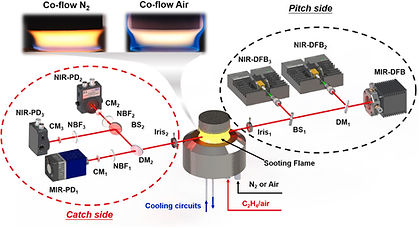
A tunable diode laser provides a narrow linewidth and a wavelength that varies with injection current. By scanning the wavelength across a molecular absorption line, the system measures absorbance. The Beer–Lambert law and tomographic reconstruction are then used to recover spatial distributions of flame temperature and species concentration.
Components
Photodetectors (Thorlabs PDA10PT-EC, 1.0–5.8 µm; PDA20CS2, 800–1700 nm); a free-space biased detector (DET100A2); imaging optics including lenses, mirrors and apertures; a precision three-axis translation stage; and a laminar premixed McKenna burner.
Capabilities
High sensitivity, stability and response speed enable quantitative, calibration-free, in-situ temperature and gas-concentration measurements in complex and harsh environments without disturbing the flow.
Planar light-extinction soot measurement
Overview
Planar light extinction is a line-of-sight measurement technique. Changes in the integrated intensity of diffuse light passing through a flame are combined with tomographic inversion to determine the two-dimensional soot concentration field.
Components
Quartz tungsten-halogen light source (Newport QTH6333); scientific camera (Andor Zyla 4.2 Plus); imaging optics including lenses, an integrating sphere and apertures; a precision three-axis translation stage; and a counterflow diffusion-flame burner.
Capabilities
Compared with conventional single-point scanning extinction measurements, this approach offers higher temporal and spatial resolution. The system is straightforward to assemble and operate, and can measure soot concentrations in unsteady flames.

Dye-laser diagnostics of combustion species and pollutants
Overview
Species and radicals in a flame absorb ultraviolet light from a dye laser and are excited from their electronic ground state. They emit fluorescence as they return to the ground state. Fluorescence intensity is positively correlated with species or radical concentration.
Components
High-resolution nanosecond dye laser (Q-scan), with a wavelength range of 200 nm–4.5 µm.
Capabilities
The Q-scan provides wavelength linearity below 2 pm for accurate scanning. Quick-change, plug-and-play dye cells and integrated nonlinear-crystal lookup tables make wide-range wavelength scans fast and convenient.

Chemical & thermal analysis
Fourier transform infrared spectroscopy–thermogravimetric analysis (FTIR-TGA)
Overview
A Michelson interferometer records an interferogram that is transformed into an infrared absorption spectrum. Flame sampling with a microprobe and a long-path gas cell enables identification and quantification of gaseous combustion intermediates. Coupling the spectrometer with a thermogravimetric analyzer also enables analysis of the decomposition products of biomass, soot and other solid reactants.
Components
Fourier transform infrared spectrometer (BRUKER INVENIO R); thermogravimetric analysis interface (TGA-IR); and simultaneous thermal analyzer (STA 2500 Regulus).
Capabilities
FTIR-TGA provides rapid measurements with high chemical specificity. Functional-group signatures support online analysis of substances with moderate to strong infrared absorption.

Gas chromatography–mass spectrometry (GC-MS)
Overview
Gas chromatography separates mixtures into individual components for identification and quantitative analysis. Separation in the column depends on the interactions of each component with the stationary phase. Coupling GC with mass spectrometry, flame ionization detection (FID) or thermal conductivity detection (TCD) enables qualitative and quantitative analysis of combustion intermediates.
Components
Gas chromatograph (7890B); mass spectrometer (5977); fused-quartz microprobe (Agilent 160-2625-5); particulate filter (Valco SS-4TF-2); heating tape (Omega FGR-060/240V); and a counterflow diffusion-flame burner.
Capabilities
The combined GC-MS system provides high mass-spectral resolution, low mass deviation, high sensitivity and complete spectra. Automated spectral deconvolution, identification and quantification simplify post-run analysis.

Particle & flow measurements
High-speed particle image velocimetry (PIV)
Overview
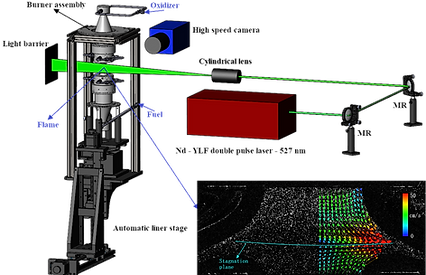
Tracer particles are introduced into the flow and illuminated by a pulsed laser sheet. A camera records two or more consecutive exposures of the particles to resolve the flow velocity field.
Components
Nd:YLF double-pulse laser; high-speed camera (Phantom Miro LAB 320); optics including mirrors and cylindrical lenses; a precision three-axis translation stage; and a counterflow diffusion-flame burner.
Capabilities
PIV is a non-contact measurement method that captures the structure and instantaneous behavior of a planar flow field. It provides quantities including mean velocity, velocity fluctuations and strain rate.
Scanning mobility particle sizing (SMPS)
Overview
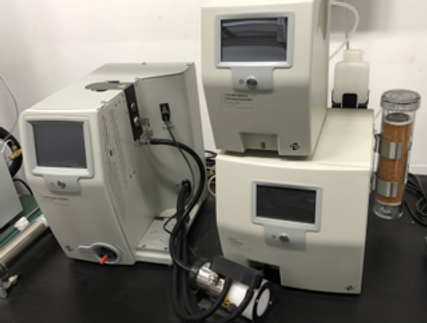
The SMPS system combines an electrostatic classifier (EC), a condensation particle counter (CPC) and a differential mobility analyzer (DMA). Sampled soot particles are classified by size and counted to determine the particle-size distribution and number concentration.
Components
Electrostatic classifier (TSI 3082); condensation particle counter (TSI 3750); nano enhancer (TSI 3757); and differential mobility analyzer (TSI 3086).
Capabilities
The system combines TSI particle-classification and counting technologies with the ability to measure particles smaller than 1 nm. It provides rapid, high-resolution size and number-concentration measurements for studies of engineered and natural aerosols, reaction kinetics and new-particle formation. Applications include nanotechnology, materials synthesis, atmospheric and environmental studies, combustion and engine emissions, and indoor air quality.
Phase Doppler particle analysis (PDPA)
Overview
The phase Doppler method uses light-scattering interference to measure particle velocity and size in a small, non-intrusive probe volume defined by intersecting laser beams. Light scattered by particles is collected by multiple detectors at an off-axis angle. The phase difference between the detected Doppler signals is proportional to the diameter of spherical particles.
Components
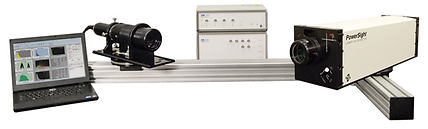
PowerSight solid-state laser (TSI) and a laser Doppler velocimetry (LDV) system.
Capabilities
The TSI phase Doppler particle analyzer provides accurate and reliable velocity and particle-size data across conditions ranging from simple flows to high-speed, low-signal-to-noise flows. It offers sampling rates up to 800 MHz and photon-counting-level sensitivity.